
HULL SHAPES FOR THE NEW POWER CATS
DESIGN OBJECTIVES
The goal was to create a hull that would be fuel efficient, sea kindly and provide enough accommodation space below decks for comfortable sleeping cabins.
THE OPTIONS
Canoe Stern Hull (Tennant style)
I was previously quite supportive of this hull shape because I had heard a lot of comments very favourable about the seakeeping ability of this hull form. My own experience with this hull type is limited to flat water but I'm prepared to accept the testimony of other on this.
When I ran the calculations it showed the CS hull form had nearly 20% more wetted area than a semi displacement hull of the same displacement. If fuel economy is a major concern at cruising speeds then I don’t consider this hull form to be in contention.
A semi circular cross section is the most efficient form to encapsulate a given volume or displacement value. When you deviate from a semi circle you increase the wetted area. If we ignore transom immersion and hull beam, wetted area is the highest form of drag at displacement speeds so a planing hull has a more drag than a semi displacement hull until it starts planing. The CS hull has considerably more area again and does not plane.
Apart from the wetted area issue the CS hull is relatively narrow and deep. Accommodation and engine room access are somewhat restricted.
The Foiling Option
The foiling cat can provide a very smooth ride in conditions that would otherwise be uncomfortable and there may be a strong case in favour of the Hysucat style foil if the vessel is regularly travelling at speed in open waters. I ruled out using the Hysucat style foil assisted hull - at least as a default configuration - because of the cost, complexity and high fuel burn at displacement speeds. Also the Hysucat foils is most efficient with an asymmetric hull form which can restrict accommodation space in the hulls.
Having lived in South East Asia for the last 16 years I’m also acutely aware the amount of debris in the ocean that could be troublesome for foiling boats operating at high speed. The potential danger to sea life is also a major issue in my view.
Semi Displacement or Planing
So the choice was down to semi displacement or a planing hull. To compare the two types for speed, consumption and seakeeping you have to have specific data for boat size, weight, engine power and the specific hull form - but in general we can say that the displacement hull will not require as much power and will be more fuel efficient than the planing hull in the speed range below the when the planing hull lifts onto the plane. However the planing hull will have higher top speed and will be reasonably fuel efficient once planing.
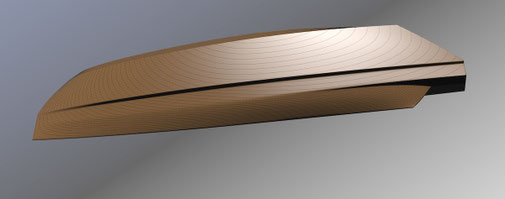
The distinction between the two hull types is somewhat blurred by being able to tune the planing hull to act more like a displacement hull by continuing the straight keel line right to the bow thereby minimising any change to trim and allowing a high deadrise angle and fine entry at the bow. The cost of doing this might mean a slightly higher liftoff speed for planing and possibly a slightly lower top speed, but it will encourage less slamming and a more comfortable ride in rough conditions.

Bow Flare
I watched a video of a particular manufacturer of planing monohulls waxing lyrical at the Miami Boat Show about how his monohull planing boats have so much flare in the bow.
What he is not telling you (or maybe not even thinking about) is that there are two downstream consequences of all of that flare.
The first is that you have a shorter waterline length in running trim. The second is that at any given point in the forward sections you have a flatter deadrise - leading to increased slamming and the consequential spraymaking.
A hull type that keeps the bow in the water has less pitching action because the hull rotates about the centre of buoyancy close to the middle of the hull and close to the centre of gravity. It makes less spray. A planing boat on the other hand is running on the flat sections aft and when it encounters waves the hull is rotating in pitch about a point much much closer to the transoms, exposing a lot more of the hull bottom to slamming by wave action.
2. SOLUTIONS
Planing hulls and foil assisted hulls provide something of a free lunch in terms of speed for the dollar spent in fuel. Well, not totally free, but certainly an advantage when the conditions are right for their operation. Shouldn’t we be taking advantage of this for our cruising cats?
I think the answer is yes, but only to the point where the boat is still comfortable and economical to operate in the conditions that are not conducive to foiling or planing.
So the ideal hull for this purpose is a semi displacement hull. If we design the hull to keep the bow in the water across most of the its speed range, incorporate a flat keel line and a reasonably flat deadrise aft then we can achieve some dynamic lift in the higher speed range without significantly increasing the wetted area. The biggest challenge then will be to minimise transom immersion which would be a drag penalty in the lower speed range. Given that we are not chasing maximum top speed we can afford to make the hull a little fatter than we would use for a high speed power cat. We know from extensive racing of sailing yachts in mixed fleets that we can safely carry a length to beam ratio as low as 9:1 without suffering any significant penalty from induced drag.
The fatter hull allows for reasonable accommodation space below decks and helps to minimise wetted area.
A hull type that keeps the bow in the water has less pitching action because the hull rotates about the centre of buoyancy close to the middle of the hull and close to the centre of gravity. A planing boat on the other hand is running on the flat sections aft and when it encounters waves the hull is rotating in pitch about a point much much closer to the transoms, exposing a lot more of the hull bottom to slamming by wave action.
So what we've arrived at is a semi displacement hull, or probably more accurately a semi planing hull given that the aft sections have low deadrise and a spray chine rather than a rounded bottom.
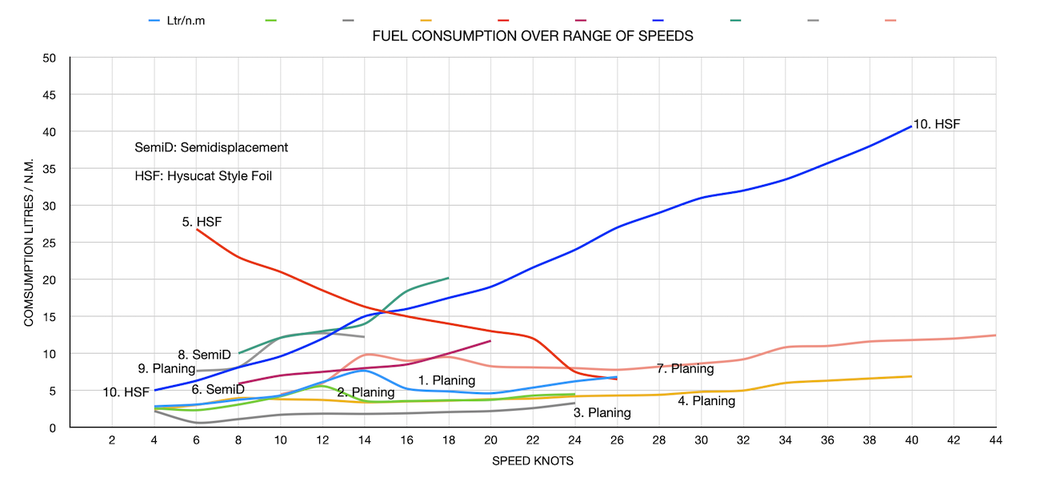
The graph plots fuel consumption against boat speed for a range of power cat types.
WHAT CAN WE LEARN FROM THE GRAPH?
The graph is the result of a study I did taking fuel consumption data published on the web for ten different power cats.
Don't despair if the graph looks like a bit of a random tangle at first. There is some interesting information in those lines, and a couple of interesting questions arise as well.
There's no big surprises in comparing the displacement hulls with planing hulls. Displacement hulls generally glide fairly easily through the speed zone that creates a bump in the curve for monohull planing boats and most planing cats. Typically displacement power cats will top out in the high teens or low twenties, whereas planing power cat can reach into the high twenties, low thirties or even higher without too much effort. The compromise for planing boats is in the sea handling if conditions are not ideal, and fuel burn at cruising speeds.
Number 5 is a real head scratcher, for me at least. It's a 40'er with a Hysucat style foil. Top speed is not too bad considering she has a lot of weight and windage. But look what happens when you back off the speed. Instant increase in fuel burn and contrary to all of the other boats sampled it just keeps rising as you go slower and slower. Could it be that the foil is optimised for top speed and not correctly trimmed for performance across the speed range?
I was only able to find figures for one other cat with Hysucat style foils - that's number 10 and its figures are quite impressive with a nice even curve right up to 45 knots. It's the largest and most powerful boat I could find data for. It would be interesting to be able to find more data for other designs with this hull/foil configuration.
MAKING THE GRAPH
The objective was to measure fuel burn at various speeds for planing hulls, semi displacement hulls and foiling catamarans.
Boat speed and fuel burn were plotted against RPM as the base reference point. Most of the data available was published in increments of 1000RPM starting at 1000RPM but some used random increments that did not coincide with our established scale, and so some extrapolating had to be done.
I found the most accurate way to do this was to plot the graph of fuel burn and speed against the RPM as published and then use draughting software to loft the numbers back to the standard increments of 1000RPM
Some examples recorded fuel burn in litres per nautical mile, some in gallons per nautical mile, some in nautical miles per litre or nautical miles per gallon, and one example brought kilometres into the equation. And so there was work to do to calibrate the figures in a fashion that we could make direct comparisons between the boats.
From there I made a graph of all the boat boat speeds up to 44 knots in increments of 2 knots and plotted the fuel burn against these numbers. In cases where the fuel burn was recorded against an odd number or deviated from the even number there was more extrapolation to do.
There may be some relatively small inaccuracies in the graph due to the extrapolation work but apart from the Number 5 plot the trends are fairly clear and predictable for the various hull types.
Keep up with fresh ideas and inspired design from Grainger Designs. We won't bug you with a barrage of emails. Maximum of two per month.
